
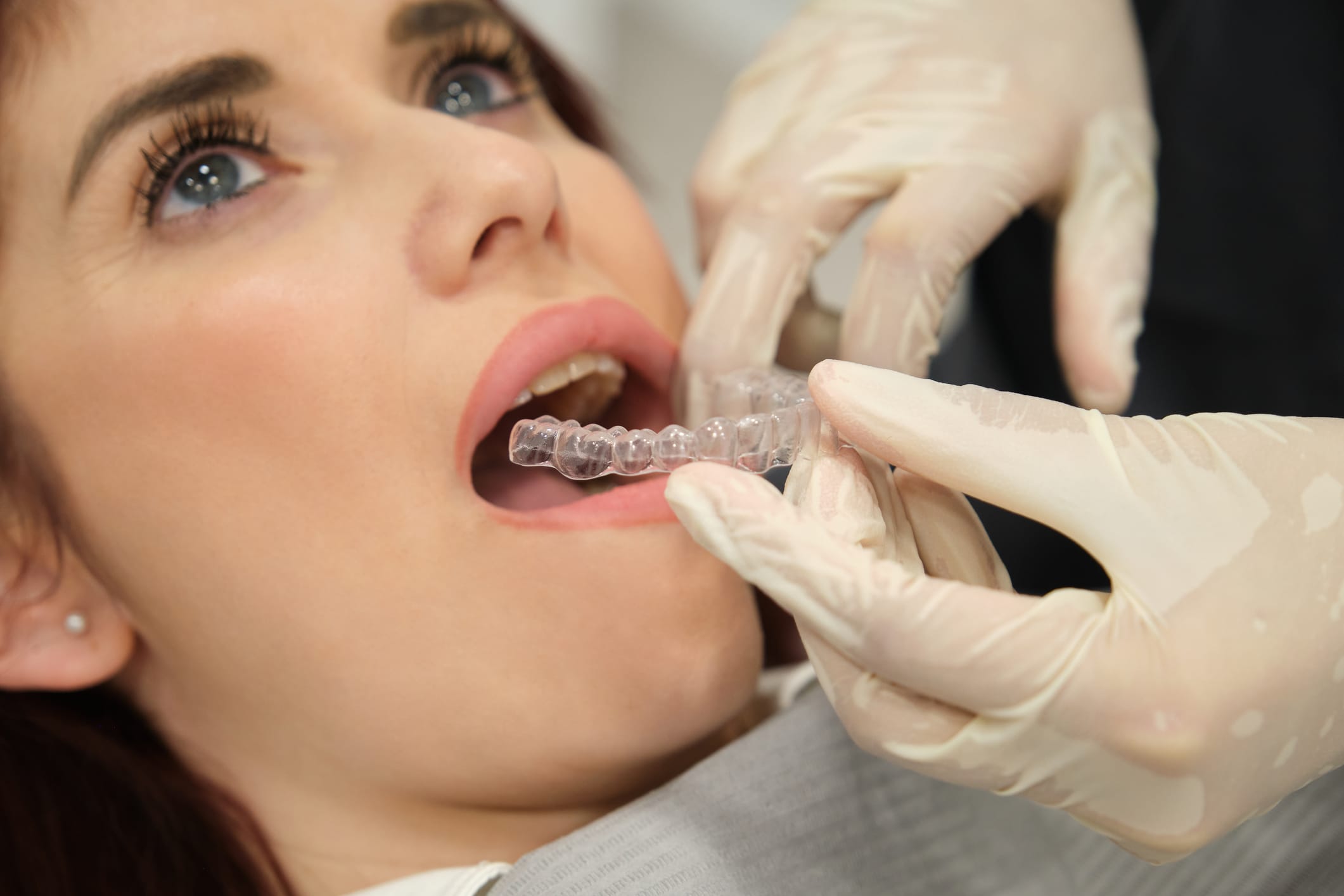
Most Invisalign treatments take somewhere between 3 and 18 months, but the honest answer depends on what you want to achieve. Straightening a couple of slightly crooked front teeth is a very different job from correcting how your upper and lower teeth meet.
It’s one of the first questions we hear at Sunbury Dental, and it deserves a realistic answer rather than a headline number. In this guide we explain what really drives Invisalign treatment time in Sunbury, why the type of treatment matters so much, and how your own habits, especially Invisalign compliance of 22 hours a day, can keep you on track or slow things down.
The single biggest factor in how long Invisalign takes is whether you need cosmetic alignment or full bite correction. Both use clear aligners, but they set out to do different things.
Cosmetic (sometimes called “social six” or limited) treatment focuses on the teeth you see when you smile, usually the front six to eight teeth on the top and bottom. It’s suited to mild crowding, small gaps, or a tooth that has drifted slightly, often after earlier braces when a retainer wasn’t worn.
Because the movements are small and limited to the front teeth, cosmetic cases typically need fewer aligners. Many finish in roughly 3 to 6 months, and Invisalign offers dedicated lighter options for these simpler cases.
The trade-off is that cosmetic treatment doesn’t aim to change how your back teeth bite together. If your bite is already healthy, that’s fine. If it isn’t, straightening only the front teeth may not be the right long-term choice.
Comprehensive treatment addresses how your whole mouth functions, not just how it looks. It’s used for overbites, underbites, crossbites, open bites, more significant crowding, and cases where the back teeth need to move.
These movements are larger and more complex, and teeth can only move safely a small amount with each aligner. That’s why full bite correction usually takes around 12 to 18 months, and occasionally longer for more involved cases. Attachments (small tooth-coloured bumps) and elastics are more commonly needed.
The benefit is a result that’s designed to be stable and functional: teeth that meet properly, wear more evenly, and are easier to keep clean.
You can’t always tell from the mirror. Some people who think they need a quick cosmetic tweak have an underlying bite issue, while others worried about a big job turn out to be good candidates for shorter treatment. A clinical assessment, including a 3D scan, is the only reliable way to know.
These ranges are a general guide to Invisalign treatment time in Sunbury and elsewhere. Your personal estimate will come from your own scan and treatment plan.
Most patients change to a new set of aligners every one to two weeks, so the number of aligners in your plan gives a good sense of the overall timeline. Your dentist may also add a short refinement phase at the end to perfect the final position.
The active aligner phase is only part of the picture. Here’s how a typical treatment unfolds from first visit to finished smile.
Wearing your aligners for 20 to 22 hours a day is the most important thing you can do to finish on time. Invisalign compliance of 22 hours is the target we give most patients, because aligners only move teeth while they’re in your mouth.
Each aligner applies gentle, steady pressure. Take it out for long stretches and that pressure stops; teeth can begin to drift back, and the next aligner may not fit properly. A few missed hours here and there add up, and a plan that should take 12 months can quietly stretch to 15 or more, or need extra refinement aligners.
In practice, 22 hours means your aligners come out only to eat, drink anything other than plain water, and brush and floss. A few habits make it much easier:
If you do lose or damage an aligner, get in touch with us promptly rather than waiting. We’ll advise whether to move to the next set or go back to the previous one.
Beyond the type of case and how well you wear your aligners, a few other things can influence your timeline:
Your treatment isn’t truly finished when the last aligner comes out. Teeth naturally try to move back towards their old position, especially in the first months after treatment, so retainers are essential to protect your result.
Most patients have a fixed retainer bonded behind the front teeth, a removable clear retainer worn at night, or both. Retention is generally recommended long term, so it’s worth thinking of it as an ongoing habit rather than a final step. It’s also the best way to avoid needing treatment again in future.
The safest way to keep treatment as short as possible is to wear your aligners for the full 22 hours, change them on schedule and attend every review. Some cases can use shorter aligner intervals, but teeth and gums need time to adapt, so rushing isn't advisable.
Many patients notice changes within the first few weeks, particularly with gaps. More complex movements take longer to become visible.
Teeth may not move as planned, aligners can start to feel tight or not fit, and your treatment is likely to take longer. In some cases we may need to order extra aligners to get back on track.
Generally, yes, because fewer aligners and appointments are involved. We'll always give you clear costs for your specific plan at your consultation.
No. You can book an Invisalign consultation with us directly.
Invisalign can be anything from a few months of cosmetic fine-tuning to a year or more of full bite correction. The best way to find out where you sit is a consultation, where we’ll scan your teeth, talk through your options and give you a realistic estimate of your Invisalign treatment time.
If you’re in Sunbury-on-Thames or the surrounding area and you’re thinking about straighter teeth, get in touch to book your Invisalign consultation.
Treatment times and suitability vary from person to person. This article is for general information and isn’t a substitute for a clinical assessment.
« Back To All News


